Antidotes to the Buzzy Mind
After Nicolás Grandi and Lata Mani’s Longing Suite

I. Meditation is Not For Me
Meditation is not for me. Over the years, I can’t even count the number of times I’ve heard that a meditative practice would be great for my overactive, overstimulated mind. The message comes from family members who have watched me drive myself into madness with repetitive, circular thoughts. It comes from the wisdom of ancient traditions like Hinduism, Buddhism, and shamanic traditions worldwide. And it is constantly repackaged and sold to me in contemporary wellness culture, as influencers stir turmeric into tea, discuss their yoga routines, and boast of the benefits of daily meditation while promoting the Calm app.
And while I believe the message, I cannot achieve what they describe as so helpful. Even the idea of sitting down to meditate conjures an almost immediate psychic pain. It would require me to slow down, sit still, close my eyes, and confront the barrage of thoughts, images, and sensations that flood in. They say this is part of the process, that one should simply watch the thoughts, images, and sensations pass. Yet just as they pass, new ones emerge. The cycle is nauseatingly endless.
Sometimes the thoughts and images are annoying. Sometimes they’re terrifying. Sometimes they’re mundane repetitions of something I’ve seen that day. And other times, I’m plunged into a thought spiral with a density and force from which I can’t extricate myself. The textures of this experience feel anything but healing. Why would I actively choose this? I’m certain this practice was simply not meant for me. Let the influencers do their thing. I’ll do mine.
II. Longing Suite
Nicolás Grandi and Lata Mani
Last weekend, I had the pleasure of attending the premiere of Longing Suite at The New Parkway theater in Oakland, CA. The film is a collaboration between feminist historian, cultural critic, and contemplative writer Lata Mani and Argentine filmmaker Nicolás Grandi. Together, Lata and Nicolás have made five films, some of which can be found here.
This was a deeply special experience for me, because in addition to being filmmakers, Lata Mani is also my aunt and someone with whom I have shared a dialogue that spans my entire lifetime. On top of that, Nicolás Grandi has now become a dear friend, one whose sensibilities stretch far beyond cinematography into literature, poetry, theater, pilgrimage, travel, and the excavation of wisdom through embodied experience. Knowing these two creative geniuses and having seen their previous work, I knew I was in for an experience that would challenge me at a cellular level. And Longing Suite delivered.
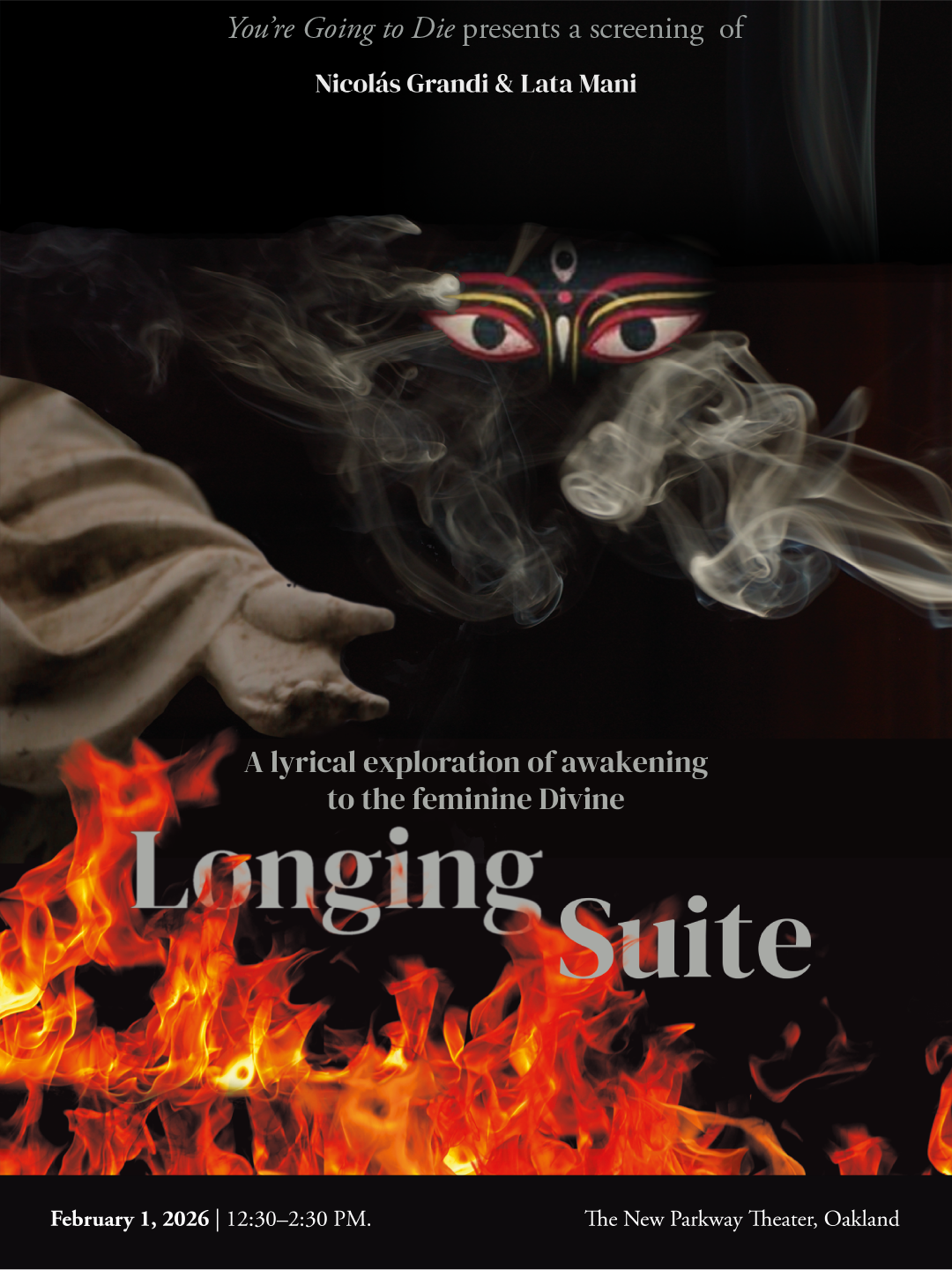
The film is segmented by 11 poems, drawn from a larger compilation of 100+ poems written by Lata in the 1990s. Structurally speaking, each poem forms part of a larger “suite” that traces the “arc” of a spiritual awakening. The film is, in this sense, intimately personal. It speaks to Lata’s journey after a life-altering car accident in the early 1990s that caused a brain injury, leaving her in bed, in a dark room, for an extended period of time during which she described “having no thoughts.” In the absence of thoughts, words, and discourse—comfortable terrain for a scholar of South Asian gender and women’s studies—Lata says she began to notice her body for the first time in her life. (You can read more about this in her 2011 book Interleaves: Ruminations on Illness and Spiritual Life).
As Longing Suite traces Lata’s arc from accident to awakening, it also gestures toward something universal. After the film’s inaugural poem, “I cannot say,” which meditates on the indescribable arrival of the feminine divine, what follows is “You who gave birth to this longing,” spoken aloud by Christopher Miles. Here, the poetic voice yearns, painfully, for a divine presence to “feed, clothe, and rear” the longing within. In the background, “Sometimes I Feel Like a Motherless Child” plays.
As the song echoes Black spiritual traditions born of slavery, we are confronted with a pervasive human feeling: that “God” has abandoned us. That day at The New Parkway, I had the feeling that everyone in the room, somehow or another, could relate. First off, the premiere was hosted by You’re Going to Die, an organization that creates space for conversations about mortality, death, and grief. And whether we’ve experienced loss through death, felt abandoned by people we love, or felt forsaken by a world that privileges profit and progress over community and wellbeing, this experience is profoundly human. Abandonment conjures a voracious longing. We long to be seen, to be held, to change the world around us, to right all the wrongs.
What starts as unsatiated longing transforms through the poetic art of Longing Suite, brushing against other experiences that feel remarkably human as well. In “Atomic Implosion,” Rosa Linda Fregoso’s voice carries us through the nuclear fission of the self, as each particle of the body vibrates in infinitely complex ways. For anyone undergoing a life transition—a new relationship, a career change, a move, or the death of a loved one—this may resonate. Life transitions for me have been like a cellular earthquake that shakes my body, mind, and heart to pieces before the ground stabilizes. Several poems later, Lata herself recites in “In Silence,” in which the poetic body expands into a kind of light and translucence. Perhaps those of us who have found peace in nature have grazed against this experience, too, when we remember to take deep breaths.
A funny thing happened to me while watching Longing Suite. In Lata and Nicolás’s earlier films—De sidere 7 and The Poetics of Fragility—I became deeply frustrated. What was being said about desire or fragility? I tried to grasp the fragmentary images and extract meaning as though I would later need to report on them in a seminar. I found it impossible to cognitively capture these ideas fully, and I was thrust into my senses, a territory within which I am obviously far less comfortable. But while watching Longing Suite, my body was calm. The megalomaniac in me wasn’t interested in capturing everything or consolidating meaning into an argument. I felt very little frustration, as I wasn’t colliding with my own cognitive limits as before. Instead, I encountered the film with a surprising balance of curiosity and detachment. I repeat: this is a miracle for someone like me.
As viewers, we don’t read poetry or pursue an argument in Longing Suite. We witness—hear, see, and feel—the evolution of a process. In this way, the film operates outside familiar cognitive modes of capture and comprehension where we read or view to “know”. Instead, we surrender to the sensuousness of each voice—distinct in cadence, tone, and accent—and to a layered soundtrack of devotional hymns, animal sounds, ambient noises, and everyday rhythms. Sound carries us forward. (It is no coincidence that Lata and Nicolás began the screening by sounding a bell. )
As we are carried, images appear. Feet walk through tall grass. A small frog chirps from within a dense, dark swamp. Hands tap stones with a noticeable rhythm. Insects wander across leaves and skin. A river flows during snowfall. Often these images appear in extreme close-up, so near we can almost feel their textures. But these scenes are layered with distant shots of the same subjects, sometimes appearing simultaneously. Multiple fragments demand our attention at once, forcing the eye to choose as a worm wriggling on a finger multiplies across the screen. As Nicolás noted in the Q&A, total capture is impossible.
Visually, Longing Suite helps us witness meditation with a curious detachment. And as you probably know, meditation is far from static, still, or contained. When I close my eyes to meditate, I see a disturbing simultaneity and multiplicity. I perceive frequent flashes of things I cannot fully grasp. I confront both the partiality and fleetingness of my perception. Thoughts flash before me and circle endlessly. I find this excruciatingly painful.
But Longing Suite teaches us to find beauty in this process. Through a seamless and layered curation of voice, song, ambient noise, photography, and moving image, the film revitalizes our perception. We are face-to-face with the undeniable beauty of a process that is unfolding without revealing its destination. Each carefully pronounced word and curated sound cradles us as we learn to see beauty in nearness and distance, in singularity and multiplicity, in nonhierarchical visuals, in that which is alive. The film’s careful pedagogy seems to suggest that we are held. It suggests that our longing is “fed, clothed, and reared”, if you will, when we learn to notice and feel our connection to the world around us, regardless of outcome.
III. Faith, Politics, and the Wish for Things to Be Okay
I’ve always struggled with faith. As a child, people around me seemed to have countless spiritual experiences: a guru appears in dreams, vibuthi manifests on household objects, a divine voice speaks through a chosen vessel. But my dreams were always ordinary and mundane. And the question of vibuthi appearing mysteriously on an altar felt easily explained by a momentary fumble. I assumed spiritual experience just wasn’t in the cards for me, and instead, I took refuge in rationality.
To be fair, the world around us doesn’t give me much motivation to keep faith either. Traditional religious models have become weapons of fascist control: consider Hindu nationalism in India or Christian fundamentalism in the United States. In both cases, we have seen religion serve as an instrument of power and indoctrination. And the institutions that preach these religions (all run by men, by the way) are unable to stand up to corruption, power, money, and greed.
And beyond that, the world feels as though it’s crumbling, and the structures of justice are being dismantled before our eyes. Genocides rage on with no regard for peace. Nations invade other sovereign nations indiscriminately, with no attempt to hide their greedy desire for control of natural resources. Police and enforcement forces torture and kill innocent people with impunity. The rule of law is exposed as fiction, as leaders with criminal backgrounds cannot be tried or punished. How is it possible to hold onto faith in a world like this?
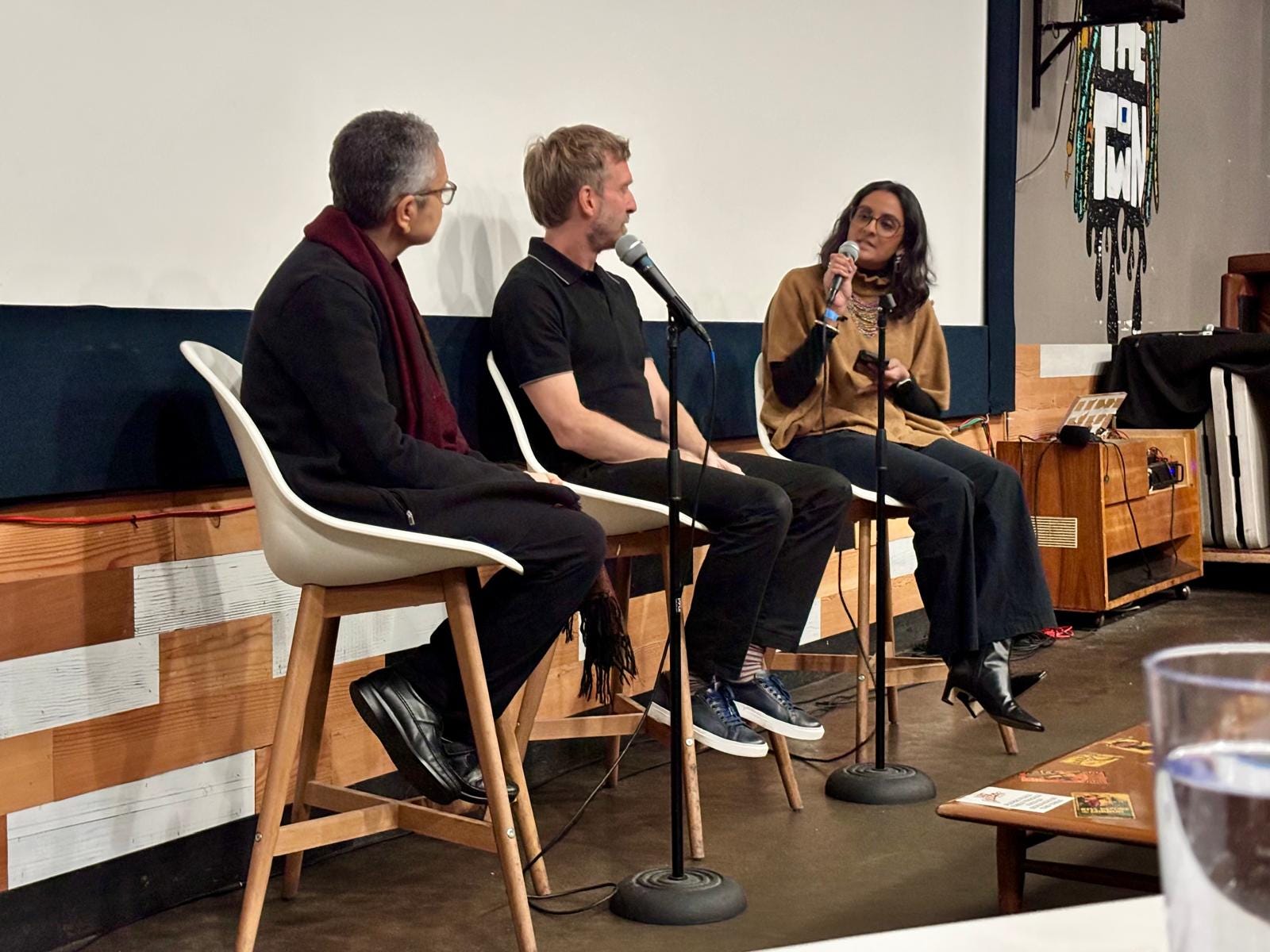
When I asked about “faith” in the Q&A, Lata answered that “faith” has become a very vexed and complicated term today. And she’s right! It has! Just notice all that I have asked “faith” to carry in these last few paragraphs alone: genocide, conquest, colonization, corruption, violence, death, and injustice. Not to mention my expectation that faith will arrive in my dreams! When I think about faith in this way and envision my own faith only through how others experience it, it is impossible to hold onto. The cards are stacked against me.
But if I’ve learned anything from Longing Suite, it’s that faith isn’t an end goal. It’s not what we achieve when the world is silent and injustice is resolved. It’s the process—the practice of showing up, witnessing, and noticing the multiplicity and complexity unfolding around us. The inconsolable sadness and the awe of a leaf dripping with morning dew. The impending fear and the sense of expansiveness of taking deep, consecutive breaths. Faith isn’t unshakeable security or safety. It’s attention.
It’s paying attention to how the world is crumbling at the same time as it’s being remade. It’s looking out at a sea of those who disagree with us and committing to witness without judgment. It’s saying, “Perhaps I don’t know the answers,” and remaining open to finding them along the way. It’s the practice of listening to our bodies, and to what the places we inhabit are telling us about the changes we need to make. Faith is not a destination. It’s the process: plain and simple. (And tiny Sowmya would be devastated to hear that it won’t arrive simply because I’ve willed my mind to conjure it correctly while dreaming).
IV. I Meditated Yesterday
I meditated yesterday. Don’t ask me how. Don’t ask me why. It just happened. And when I did, I saw the same flashes of light and had the same frenetic thoughts. They were all there: the to-do lists, the regrets, the memories, the things I wish I could change.
           But with each flash, a distinct sparkle; with each thought, a new hue.
                   Regrets and memories: a body alive.
                             To-do’s and things to change: the reason to keep going.
Don’t ask me how I got here from “I cannot meditate.” I truly have no idea what gave me the strength or the desire, and I don’t know if it’ll ever happen again. But I do know that I was gifted a new way of seeing—and relating to—the very same things. And perhaps that’s exactly what we need in today’s world, where old problems repeat themselves ad nauseam.
Anyway, just go see Longing Suite. And trust the process.